
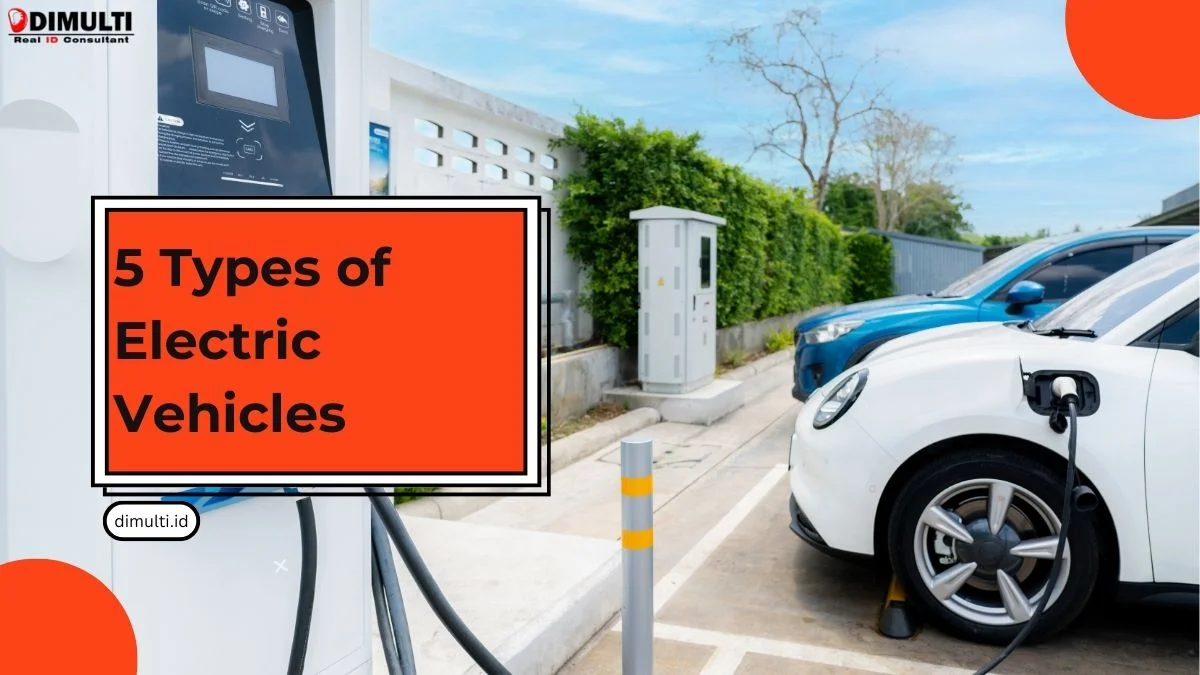
Types of Electric Vehicles – The use of electric vehicles is on the rise. This is also based on increasing public awareness of the environment, because electric cars almost don’t emit gas emissions that are harmful to the environment.
However, did you know that electric vehicles also have several different types and have different functions and specifications?
So, what are the types of electric vehicles? let’s see the explanation only at dimulti.id!
Also Read


Table of Contents
Types of Electric Vehicles

1. Battery Electric Vehicles (BEV)
The first is battery electric vehicles, also known as BEVs.
These electric vehicles are probably everyone’s perception when they hear the word “electric vehicles” as these vehicles are powered 100% by batteries and electric motors.
This type of electric vehicle, which is also often known as the “all-electric vehicles” or “pure electric vehicles”, is equipped with rechargeable batteries which usually use lithium batteries.
This is because these batteries have a high power-to-weight ratio, which in turn provides a longer driving range.
These electric vehicles are also 100% zero-emission, producing no harmful emissions or air pollution.
Generally, BEVs have a range of 50-350 miles on a single charge depending on the manufacturer.
2. Hybrid Electric Vehicle (HEV)
The next one is the hybrid electric vehicle or HEV. Hybrid Electric Vehicle (HEV) is a type of electric car that uses two power systems, which are the combustion engine and an electric motor.
And also, the HEV electric vehicles cannot be charged externally because they do not have a charging port.
However, the battery in HEV can actually be charged while braking, a process known as regenerative braking.
During braking, the traction motor acts like a generator, functioning to charge and store electrical energy in the battery. Meanwhile, the internal combustion engine (ICE) receives energy from gasoline.
Because it also receives energy from fuel, the HEV will still have a fuel tank similar to other non-electric vehicles.
The advantage of using this type of vehicle is that it has much lower emissions compared to conventional ICE vehicles, as well as lower fuel consumption.
3. Plug-in Hybrid Electric Vehicle (PHEV)
The next type of electric car is the PHEV (Plug-in Hybrid Electric Vehicle). Just like HEV, the PHEV also uses two drive systems, which are electric motors and internal combustion engines.
The most significant difference between HEV and PHEV is the PHEV’s ability to charge its battery externally due to the presence of a charging port in this vehicle.
PHEVs can usually operate in at least two modes: all-electric mode where only the electricity in the battery that powers the car and hybrid mode where electricity and gasoline are used together.
Some types of PHEV electric cars are able to travel more than 70 miles using electricity alone.
PHEV electric cars usually start in all-electric mode and run on electricity until the battery runs out.
While some PHEV models can switch to hybrid mode when the vehicle’s speed is stable on the highway, generally above 60 or 70 miles per hour.
Then, when the battery is empty, the engine takes over and the car operates as a conventional non-plug-in hybrid.
Also Read: “Electric Vehicle Battery Types“
4. Fuel Cell Electric Vehicle (FCEV)
The FCEV type of electric car is also known as a Fuel-Cell Vehicle (FCV) or Zero Emission vehicle.
FCEVs use hydrogen as an energy source to generate electricity from a fuel cell system. The electricity is then used to power the motor to run the vehicle.
The way an FCEV electric car works is almost similar to a BEV electric car. It’s just that the FCEV type has a system that converts chemical energy in the fuel-cell into electricity.
The FCEVs generally can reach around 300 miles on one tank of pure hydrogen, and usually utilize regenerative braking technology to capture energy lost during braking to then be stored in a battery pack.
5. Solar Electric Vehicle (SEV)
The last one is the solar electric vehicle or SEV. Like its name implies, the SEV uses photovoltaic cells like those used in solar panels.
This device then converts energy generated from sunlight into electricity which in turn powering the electric motors in this vehicle.
The SEV generally has the cheapest cost of operation because the generated solar energy is completely free for us.
Other than that, when the sun won’t come out, the SEV can acts like BEV and you can charge it directly using regular EV chargers.
So there you have it! The 5 types of electric vehicles for you!