

What are the 9 parts of an electric fan? What are their functions? Let’s take a look at the explanation that we’ve prepared just for you!
It’s a hot summer day, and you’re just lying around your house in the living room by couch, with the cool breeze of air blowing into you.
Yup, an electric fan is one of the most reliable tools to get rid of the heat especially on a hot summer day.


Although it’s not as potent as an air conditioner, electric fans still do its job fairly well in cooling down the environment in our house.
But, an electric fan wouldn’t be as good as it could be if it’s not because of the parts that working together in harmony in making a cool breeze.
With that being said, it’s important to know the parts of an electric fan, not only to get an insight into how this thing works, but also to give you a better understanding of how to maintain the electric fan.
So, enough with the chit-chat, let’s dive into it!
Parts of an Electric Fan
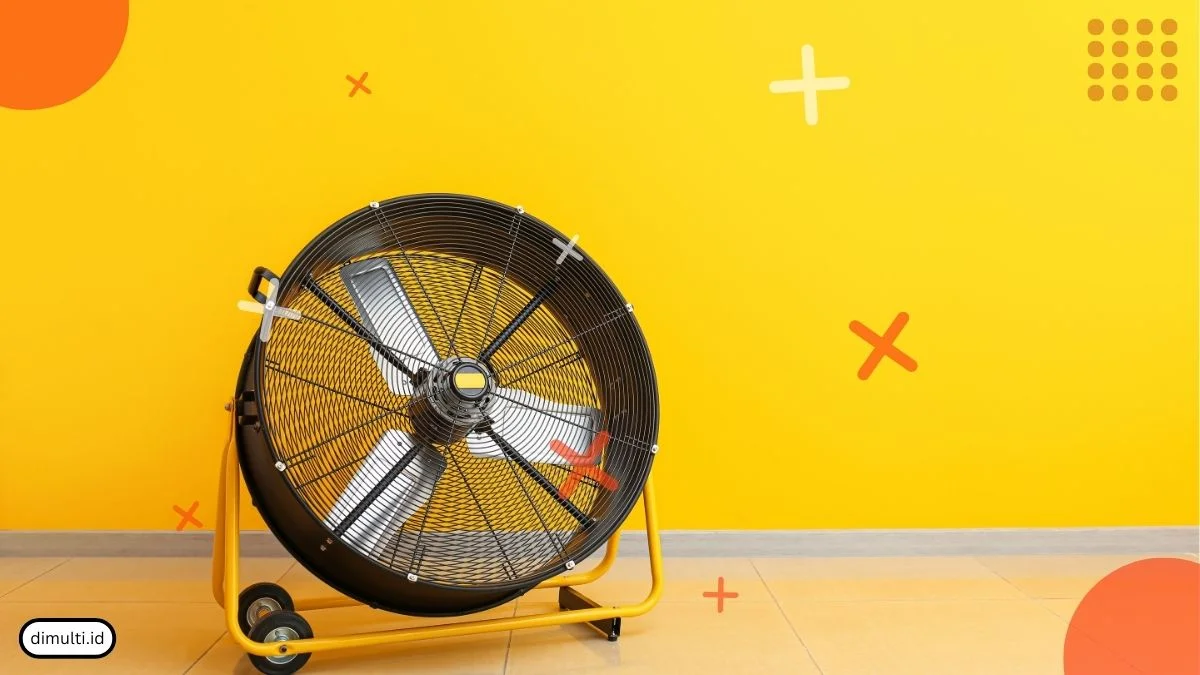
Each fan consists of various fan components that have their own functions and uses. Starting from the driving dynamo, blade, to the cable.
The following is a complete description of the fan components and their functions. Check this out!
1. Electric Motor
The first component of the fan is the electric motor. Did you know? The electric motor is the main component of the electric fan, and considered as the beating heart of electric fans.
The electric motor contains several other parts, such as electric wiring, stator, and rotors.
The main task of the fan’s electric motor is to rotate or move the fan blades. To be able to move the electric motor you need enough electrical energy and need another component, such as the fan capacitor.
2. Capacitor
Talking about capacitors, the next one on our list is the fan capacitor. But, what is the main function of the fan capacitor?
The function of this one fan component is as a storage area for electrical power. Which will then be used when the fan makes the initial rotation on the electric motors.
When the fan engine rotates, the fan capacitor will be disconnected from the electricity automatically. In general, fan capacitors are in the size range of 1.5 μF to 3 μF.
An electric fan’s capacitor is likely divided into several phases to create the magnetic flux. This makes the fan spin towards the produced magnetic field.
Also Read: “7 Types of Fans“
3. Fan Blades
Well, this is the part that defines an electric fan, and also the part that is responsible for giving a nice cool breeze around your room.
The main function of this fan component is to suck air from outside, then exhale it back in the opposite direction.
Fan blades also can come in a variety of numbers such as three, four, or more. You can also choose from a plethora of blade designs to suit any style.
The material for making fan blades that is often found on the market is lightweight plastic material.
The reason is that this material tends to be more lightweight thus making it easier to rotate. But there are some electric fan models that use aluminum as its material of choice.
4. Wire Guard
There is also a wire guard component. Well, as its name implies, the main use of this fan component is to protect the fan from external things that can damage the fan.
Well, other than that, the wire guard also serves to protect us from fast rotating fan blades that will be very dangerous if the component is not protected, especially if there are curious children or pets around the house.
5. Back Cover
The next fan component is on the outermost part of the fan. That’s the fan back cover.
The main function of the fan back cover is to act as a protector or holder of the electric motor inside the fan.
Fan cover materials are usually made of insulating materials, or materials that are resistant to exposure to hot temperatures.
6. Gear Box
Ever wonder how your fan has different speed settings? Well that’s the gear box that is responsible for giving you that feature.
This is your electric fan’s main unit, located at its head and is mostly consists of mechanical hardware.
The main function of the gearbox is to control the energy output to either reduce the speed or increase the torque, giving you the options to change its speed from low, medium to high.
7. Switch
When you flip the switch, your fan instantly turns on. Seems easy, right? However, there is actually a more complex process behind it.
When you turn on the switch, the electric current from the main cable immediately flows into the fan motor.
While this process may seem simple and quick, there are a series of mechanisms that work efficiently in a split second.
The power switch serves to connect the electric current from an external source and send it to the fan motor, allowing the fan to spin and generate wind.
While all of this happens very quickly, each step in this mechanism plays an important role in ensuring the fan functions properly.
Also Read: “SNI Certification for Electric Fans in Indonesia“
8. Oscillator Knob
One of the main features of an electric fan is its ability to move dynamically. To get a more even wind distribution, you would want a fan that can rotate back and forth.
This feature is controlled by an oscillator knob, whose function is to allow the fan to move in an oscillatory manner. This knob is usually located at the back of the fan head.
It protrudes out of the fan cover and is designed to make it easier for the user to adjust its movement.
By pulling the knob upwards, you activate the oscillation mode, so the fan will move in a sweeping manner.
On the other hand, pressing the knob down locks the fan in a fixed position, so the wind is only directed in one direction with no movement.
9. Power Cord
The last component of the fan is the plug and cord. Its function is to connect the fan to a power source.
Now, this plug will be plugged into a socket, allowing electricity from an external source to flow into the fan.
The cable, which is connected to the plug, carries the electric current from the socket to the motor and other components inside the fan, allowing the device to function properly.
So there you have it! The 9 main parts of an electric fan along with its function!
The electric fan is one of the many products that are mandatory to be certified by the SNI certification in Indonesia.
This is because the risk of an electric fan might be concerning for the Indonesian consumers, as the fan that is not properly manufactured can cause a failure and be dangerous for the users.
The electric fan that is about to be distributed in Indonesia must undergo a series of tests to determine its quality and safety.
After all of those tests have passed and the electric fan is met with the requirements that have been set, the electric fan is ready to be distributed and sold in the Indonesian market.
For the electric fan, the regulation is clearly stated in SNI IEC 60335-1:2009






This is a great explanation of the parts of an electric fan! I never realized how many components work together to keep us cool during those hot summer days 🌞. It’s amazing how a small capacitor and motor can make such a big difference in how well the fan works! Definitely something I’ll keep in mind for when I need to maintain my fan. Thanks for sharing this helpful info! 😊
Hello Faizan, thank you for leaving comments! It’s good to know that what we wrote can be informative and applicable for everyday life 🙂