
What’s the Difference Between Laminated and Tempered Glass? As the demand for “safety glass” increases especially for commercial buildings, these two types of glasses are the two most common products used for building’s safety!
Forced entry has become a major safety problem for owners of commercial buildings. Even while big windows and doors are necessary and visually appealing for these kinds of structures, robbers frequently target these areas because they represent a building’s weak point.
With that being said, these two products are the most commonly used safety glass. But what is the difference between laminated and tempered glass?
Also Read


Laminated vs Tempered Glass
Before we dive down into the differences between those two, let’s break down what is a laminated and tempered glass?
1. Laminated Glass
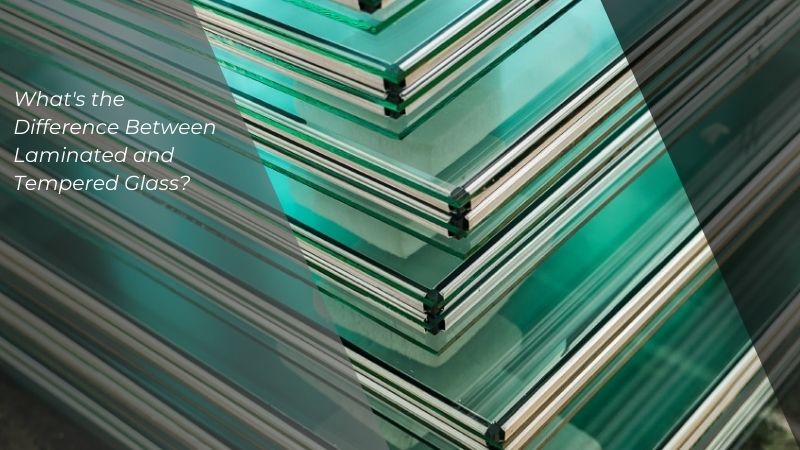
A laminated glass is created from two pieces of tempered or regular glass that is sandwiched together with a layer of clear plastic film in the middle of it.
After treating the glass to remove any air pockets or bubbles, it is heated for the initial melting process.
Following this process, the glass is heated once more but this time under pressure to complete the glass products. Also, adding more layers results in stronger laminated glass.
And also you can ensure that the laminated glass is placed in its position properly by slightly stretching it (not in a rubber band way, though)
2. Tempered Glass
Tempered glass is an ordinary glass (annealed glass) that has undergone a heating and cooling process that gives its safety characteristics. This heating and cooling process is called “tempering”, hence the name “tempered glass”.
Glass is heated and cooled quickly during tempering, which gives the glass an intriguing development of its safety features.
In other words, hot glass that cools quickly solidifies more quickly on the outside than the interior.
Because the glass is left “in tension” in the middle as a result of this procedure which make it far stronger and more resilient than untempered glass.
Also Read: “Everything You Need to Know About Bulletproof Glass“
Difference Between Laminated and Tempered Glass
1. Production Process
The first difference between laminated and tempered glass is in its production process.
A laminated glass consists of two or more sheets of glass connected with an elastic polyvinyl butyral (PVB) film layer. The production process involves placing a PVB layer between the glass sheets and heating to unite the two materials.
On the other hand, tempered glass is made through a process of rapid heating and cooling called tempering.
Glass is heated to high temperatures and then chilled suddenly using air or special coolant. This process creates a compression tension on the glass surface, which gives a tempered glass an extra strength.
2. Safety
The second one is the safety aspects of these two.
Laminated glass is very safe because if it breaks, its remains will stay in a single sheet due to the presence of a PVB layer. This reduces the risk of injury from sharp glass breaks. Laminated glass also has impact resistance and is resistant to shock or vibration.
On the other hand, tempered glass is also safe because of its high strength. And also, if it breaks, it will break into smaller fragments that are safer than sharp ordinary glass fragments. These small fragments have more fine edges and are less dangerous.
Also Read: “What is Tempered Glass?“
3. Strength
Laminated glass has good strength due to the PVB coating that binds the glass sheet together. PVB layers give extra strength and maintain the integrity of the glass even when there is a crack or impact.
Tempered glass has a higher strength than laminated glass as the tempered glass can withstand greater physical pressure and is more resistant to impact, heat, and drastic temperature changes.
4. Installation
Laminated glass is generally used in applications where safety is a priority, such as doors and windows and also often used in structural applications, like floor glass or glass roofs.
Meanwhile, tempered glass is generally used in applications where strength and safety are the primary concerns. These include shower doors, partition walls, and window glass in areas that are vulnerable to impact or damage.
There you go! The difference between laminated and tempered glass in one go!
Those two products are the most commonly used safety glass in the market, with a diverse functionality and choosing the right one according to your need is a thing to thoughtfully consider.
But, other than that, one thing that you should consider is its quality and whether the laminated and tempered glass you have is safe enough.
Look for the glass that has an SNI logo on it to ensure the safety aspects of those glasses.
The SNI logo is a proof that your glasses have already been tested for its quality and safety to gain the SNI certification, thus making it safer to use.
The SNI certification itself is a type of certification that regulates all of the products and or services that are sold or distributed in Indonesia.
For the laminated and tempered glass itself, it is a mandatory thing for any importer or business owners to register their products for the SNI certification.
So, if you’re either a business owner or importer that needs the SNI certification for you tempered or laminated glass, kindly check this link, HERE.