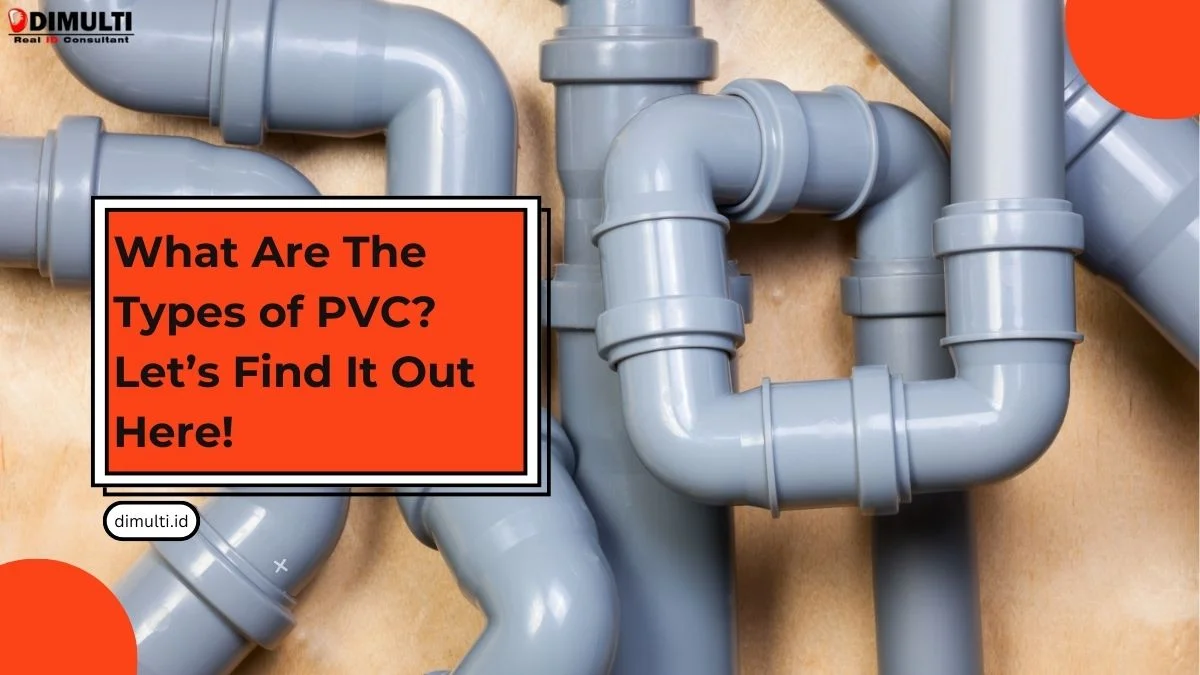
You might have never heard about the types of PVC, right? Although PVC is the most common material used in many products, the types of PVC can sometimes be overlooked.
From pipes that deliver water to our homes to conduits that protect electrical cables, PVC is everywhere in our daily lives.
So today in this article, we’ll dive deeper into the types of PVC that exist, their respective uses, and why this material is so versatile.
Let’s strap in and get ready to understand more about a material that you may have come across but didn’t know much about!
Types of PVC
PVC is a polymer composed of vinyl chloride monomers, which is more fire-resistant and stronger than polyethylene.
Typically, the application of PVC is used for cable wrapping materials, rods, pipes, floor coatings, and even vinyl records.
Worldwide, over 50% of PVC produced is used in construction. For building materials, PVC can be said to be one of the most durable materials there is and on top of that it is relatively cheap and easy to assemble.
To make PVC more flexible and elastic, it is usually possible to add a plasticizer agent which is usually in the form of phthalates.
Well, this phthalate-added flexible PVC is usually applied to piping materials, roofing, electrical cable insulation, and clothing materials.
Also Read: “The Differences Between PVC Conduit and PVC Pipe“
1. Plasticized
Plasticized or flexible PVC is a type of PVC that has a density of about 1.1 to 1.35 g/cm³.
The manufacturing of this type of PVC involves the addition of plasticizers, substances that make it more pliable and flexible compared to regular PVC.
Plasticizers act like lubricants in plastic materials, reducing rigidity and increasing the clarity of the material, resulting in PVC that is not only more malleable but also more elastic.
Because of its flexibility, plasticized PVC, or PVC-P as it is often called, is very useful for a variety of applications that require a material that can conform to shape and be easily installed.
Examples of its applications include electrical cables, yoga mats, and surface coatings.
2. Unplasticized
Unplasticized PVC, or rigid PVC, has a density of about 1.3 to 1.45 g/cm³. This type of PVC, also known as UPVC, PVC-U, or uPVC, is a hard and cost-effective plastic.
One of the main advantages of rigid PVC is its high resistance to impact, chemicals, water, as well as various weather conditions and corrosive environments.
These advantages make rigid PVC very popular for various applications that require strong and durable materials.
Examples include water pipes, windows, and doors, where strength and resistance to external elements are essential.
3. Molecularly Oriented PVC
The next one on our list of types of PVC is the molecularly oriented PVC or also commonly known as MOPVC.
Molecularly Oriented PVC, is a type of PVC that has undergone a special manufacturing process to align its polymer chains in a specific direction.
This process, called molecular orientation, involves drawing the material at high temperatures to arrange the polymer chains in an orderly and directional manner.
This alignment improves the material properties, providing higher tensile strength, better impact resistance, as well as superior dimensional stability.
Examples of MOPVC uses include pipes for high-pressure systems, packaging that requires extra strength, and industrial components that need better durability.
4. Chlorinated Polyvinyl Chloride
Chlorinated Polyvinyl Chloride (CPVC) is a type of PVC that has undergone chemical modification by adding chlorine atoms to its polymer chain.
This chlorine addition process increases the material’s ability to withstand high temperatures and various chemicals, making it far superior to standard PVC in terms of heat resistance and chemical resistance.
It is mainly used in hot water piping systems, chemical piping systems and in industrial settings where heat-resistant is mandatory.
5. Modified PVC
Modified PVC or also refers to M-PVC is the type of PVC that has undergone additional processing or chemical treatments to alter its properties and make it suitable for specific applications.
These modifications can enhance factors like heat resistance, impact resistance, flexibility, or chemical resistance.
So there you have it! The types of PVC!
The applications of PVC are indeed so diverse in a lot of settings, but one thing that is so important is to choose the PVC product that has been tested for its quality and safety.
As in Indonesia, the PVC products are needed to be tested then certified to ensure that it is safe to be sold and distributed in the markets.
The said certification is called the SNI Certification that regulates most if not all of the products and/or services in Indonesia.
And for the PVC itself, the regulations are as diverse as its applications. From the SNI certification for PVC insulated cable that stated in 04-6628.3-2006, 04-6628.4-2006 and 04-6628.5-2006.
And up to the SNI certification for PVC casted boots that is stated in SNI 1547:2017, and everything in between.