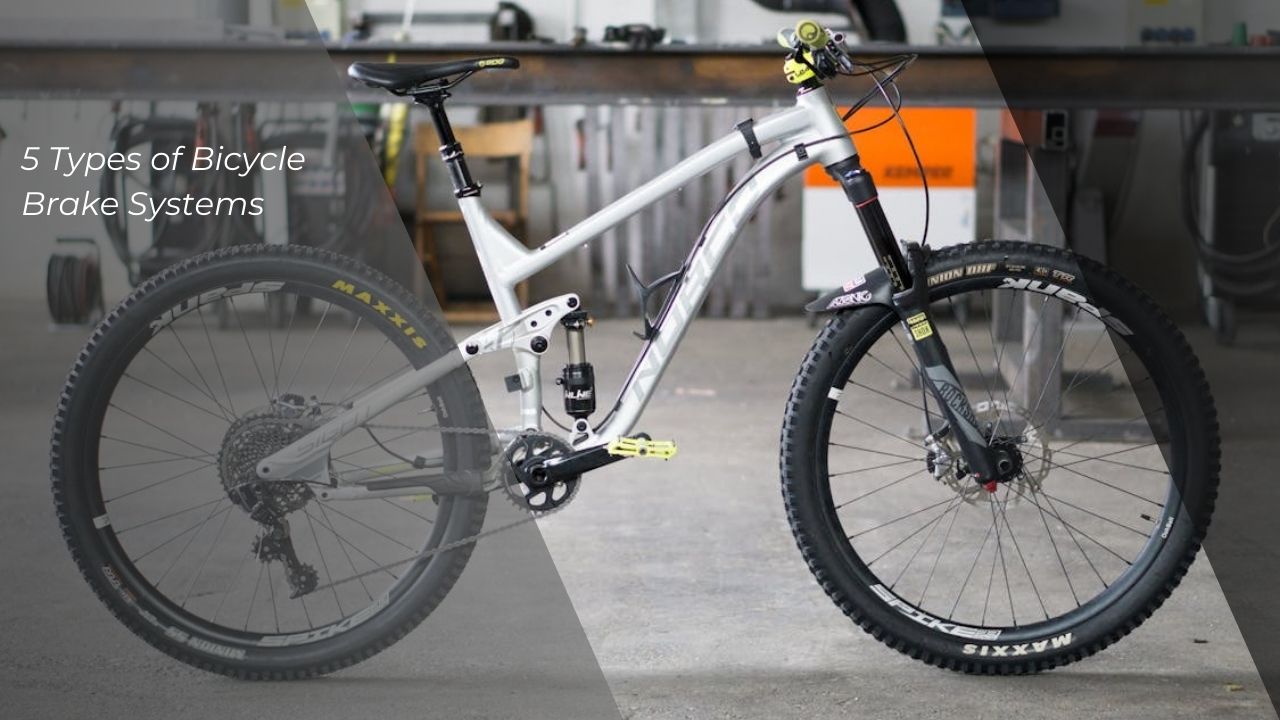
5 types of bicycle brakes to consider before you buy your next favorite ride!
Brakes are one of the most important aspects in bicycles, and with the evolution of bicycles, many brakes are developed to fulfill the needs of every biker.
So stay tuned as we uncover what are the 5 types of bicycle brakes that you need to know!


Types of Bicycle Brakes

Riding a bicycle can mean many different things for different people, some are using bikes as a mode of commuting, some are doing it for a hobby and the others love riding a bicycle to gain its health benefits.
With the evolution of bicycles, the bicycle’s brakes also evolved in the pursuit of maximum braking performance and safety regulation.
Different types of brakes are available in the market, with each brake possessing different characteristics and mechanisms.
1. Rim Brakes
The first one being the rim brakes, this brake also being the most widely used brake in bicycles.
The rim brakes operate by squeezing brake pads onto the wheel’s rim, creating friction , thus slowing down your bike.
This brake also have different categories.
- Caliper Brakes: These brakes have a single arm that is straddled by two brake pads. There are several categories into which caliper brakes fall:
- Side-pull Caliper Brakes: The side-pull caliper brakes is the most common type of caliper brakes, the brake cable is only pulling one arm of the caliper towards the rim.
- Center-pull Caliper Brakes: The caliper brake with both of the brake pads pulled simultaneously towards the rim.
- Cantilever Brakes: These brakes are often found on mountain bikes, with separate arms mounted on the frame or fork to allow for greater clearance around wider tires. They come in two main variations:
- Traditional Cantilever Brakes: The two brake arms are connected with a cable.
- V Brakes: Popular on many hybrid or cyclocross bikes, this type of brakes uses a single cable that splits into two arms and offers powerful braking.
Pros of rim brakes:
- Simple and lightweight design
- Cheaper
- Easy maintenance
Cons of rim brakes:
- Reduce braking performance if it gets wet.
- Less powerful braking
- Can cause rim wear overtime
Also Read: “Types of Bicycles: A Thorough Guide“
2. Disc Brakes
The next one is rim brakes, these types of brakes have become increasingly popular in recent years.
By squeezing the brake pads against a disc that is attached to the wheel, disc brakes offer a better braking power and performance to that of rim brakes.
There are two main mechanisms that you can find on disc brakes.
- Hydraulic Disc Brakes: Hydraulic disc brakes use a closed hydraulic system that is filled with fluid. By squeezing the brake level, it will transmit pressure through the fluid to the caliper pistons thus forcing the brake pads onto the discs. This type of brake offers a powerful and consistent braking with minimal hand effort.
- Mechanical Disc Brakes: Similar to rim brakes, mechanical disc brakes use a cable that moves the pads onto the disc. While having a better braking performance over rim brakes, mechanical disc brake still require more hand force compared to hydraulic systems.
Pros of using disc brakes:
- Braking power is not affected by weather
- Less rim wear
- Better braking performance
Cons of using disc brakes:
- More expensive
- Harder to maintenance
- Heavier than rim brakes
- Needs a compatible wheels and frames for installation
Do you ever wonder about going out on the road with your bike then suddenly your bikes experiencing some malfunction?
Well, it is not anymore a problem if your bike is certified by the SNI certification in Indonesia.
This type of certification will ensure that every bicycles that are sold and distributed in Indonesia are up to Indonesia’s safety standard.
So if you are interested in this matter, go check this link!
3. Coaster Brakes
Also known as the backpedal brake, this simple and low maintenance braking system is usually found on single speed bikes.
Coaster brakes operate through a freewheel mechanism in the rear hub, if you pedaling forward, your bike will move forward while doing it backward engages the brake by locking the rear wheel.
Pros of using coaster brakes:
- Simple design
- Minimal maintenance
- Easy to use
Cons of using coaster brakes:
- Limited braking power
- Braking only applied on the rear wheel
4. Roller Brakes
Invented by Shimano, a cycling company’s giants, this type of brake uses internal hub brake with small rollers to provide friction and stop the wheels.
Pros of using roller brakes:
- Weatherproof
- Low Maintenance
- Clean Operation
Cons of using roller brakes
- Heavyweight
- Less braking power
- More complex
5. Drum Brake
Drum brakes is a type of internal hub brake that uses expanding shoes to create friction that slow down the wheel.
It is usually installed within the rear bike, when the brake lever is squeezed, it will pull a cable and make the two brake shoes inside the hub to spread outwards.
The brake shoes are pressed against the inner surface of a rotating drum within the hub, creating friction that slows the wheel down.
Pros of using drum brakes
- Weatherproof
- Low Maintenance
Cons of using drum brakes
- Heavyweight
- Less braking power
Here you are 5 types of bicycle brakes system to consider!