
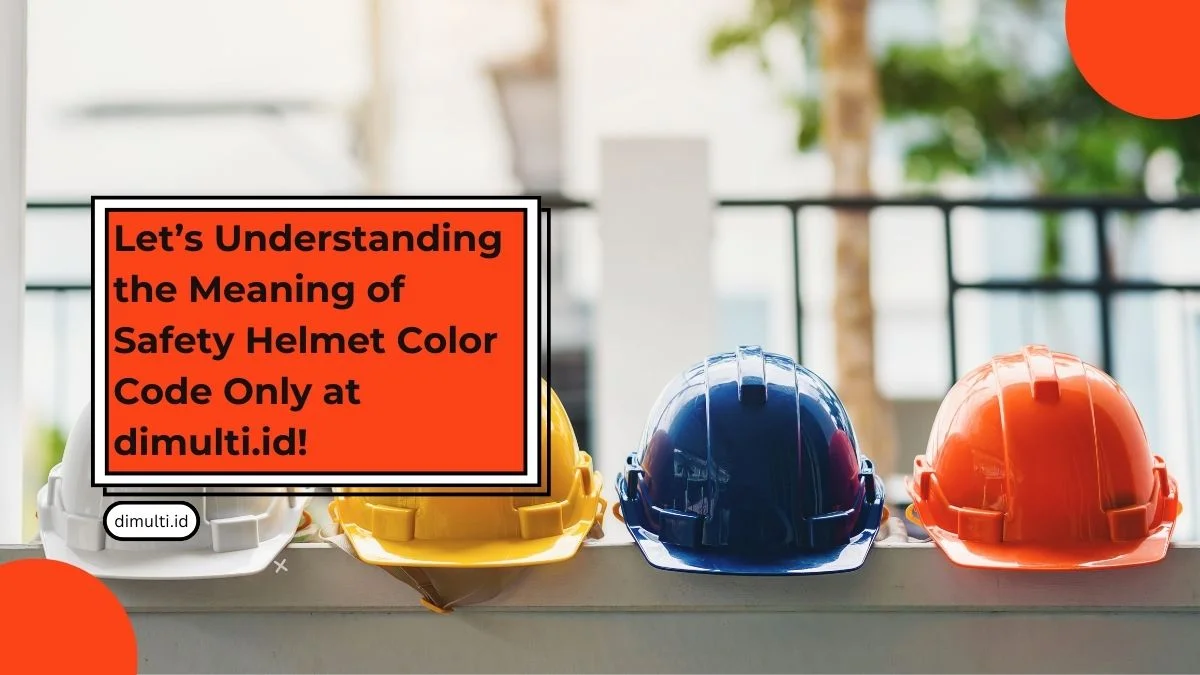
Safety Helmet Color Code – Occupational safety helmets are one of the mandatory self-protection equipment(PPE) for workers, especially in the construction field.
If you notice, the work safety helmets used in construction projects consist of several colors. So, what does the color of the work safety helmet mean?
In this article, dimulti will discuss together what the color of the safety helmet means and its usefulness for safety in the project environment. Let’s check this article to the end for more information!


What is a Safety Helmet?

Safety helmets are a special type of helmet designed to provide maximum protection against risk of head injury in hazardous work environments, such as construction projects.
The helmet is made from strong and pressure-resistant materials, and has an ergonomic design to make it comfortable to use for long periods of time.
The work safety helmet material consists of two main components, the hard exterior made of ABS (Acrylonitrile Butadiene Styrene) or solid fiberglass, and the coarse interior made of materials such as EPS (Expanded Polystyrene) foam to absorb energy when a impact occurs.
Also Read: “Types of Safety Gloves“
Safety Helmet Color Code

Each color of the safety helmet has its own meaning and usefulness in maintaining the safety.
The color of the helmet is not just aesthetic, but a visual identification that facilitates the organization and grouping of workers according to their functions or duties.
Here’s an explanation of the commonly used safety helmet colors and their usefulness.
1. Yellow Safety Helmet
Yellow helmets are commonly used by construction workers, heavy duty operations and laborers.
The striking yellow color makes workers easily recognizable, especially in rather busy work areas.
Workers with yellow Helmets often have an important role in overseeing projects and ensuring safety at workplaces.
2. Blue Safety Helmet
Blue helmets are usually worn by technicians or electrician operators. They indicate that they have a role in operating heavy equipment such as construction machines. Blue helps in identifying and coordinating the workers responsible for such machines.
3. Green Safety Helmet
The green helmet is often used by construction workers involved as a safety inspectors and also probationary workers.
4. Red Safety Helmet
Red helmets are often worn by medical workers or emergency workers. This indicates that workers have specialized knowledge in dealing with injuries or medical conditions at the workplace.
5. White Safety Helmet
White helmets are usually worn by project managers or engineers. This is a sign that the employees have a responsibility to oversee and manage the project as a whole.
White helmets reflect the role of leadership and great responsibility for the safety and progress of the project.
6. Orange Safety Helmet
The next one is the orange safety helmet, this color indicating individuals that are working in high-visibility positions.
It is usually worn by road workers, traffic controllers and construction equipment operators,
7. Brown Safety Helmet
The brown-coloured safety helmet is an indication that the wearer is intended for people working in the welding sector or other fields of work involving high temperatures.
8. Gray Safety Helmet
The gray safety helmet is usually used by visitors in a construction site.
Also Read: “Types of Safety Glasses“
Benefits of using Safety Helmet

Using a work safety helmet is not just for complying with the rules, but also about protecting yourself and your colleagues.
Here are some important benefits of using a work security helmet in a project environment that you need to know.
1. Protecting Your Head
The safety helmets are specially designed to protect the head of the worker from a variety of threats, including heavy impact, falling objects, or other accidents commonly occurring at a construction site or other project.
Equipped with robust design and quality materials, the work safety helmet is able to absorb the energy from the impact.
2. Identifying Role
In addition to being a protective tool, the work safety helmet also plays an important role in identifying the roles and functions of each employee at the project site.
In this case, project leaders and colleagues can easily identify employees with specific responsibilities.
This facilitates coordination and communication between employees, so that the project can run more efficiently and safely.
3. Complying with the Rule
The use of occupational safety helmets is not just a personal safety issue, but one of them is compliance with safety working environments regulations.
Every country has regulations that require the use of a safety helmet in a construction or any other working environment.
Compliance with these regulations is crucial, as it not only protects workers, but also ensures that the project runs in accordance with safety standards that have been established by the relevant authorities.
4. Minimize the Risk of Injury
The risk of head injury in the construction working environment can be very high, especially when different types of work take place simultaneously.
When you wear a safety helmet, the risk of head injury can be significantly minimized. These helmets are designed to absorb the energy from the impact, thereby reducing the impact of injury.
It is important to bear in mind that the use of safety helmets is a shared responsibility. All employees and project supervisors must ensure that everyone at the workplace wears a work safety helmet that matches the color indicating their respective roles and functions.
So, when you see a project worker wearing a helmet of a particular color, remember that the helmet is a symbol of safety and responsibility in the work of the worker.
Also Read: “Construction Safety Equipment“
So there you go! The safety helmet color code!