
Types of Laser Cutting – Laser cutting is one of the most versatile tools to be used in various applications.
Moreover, there are many industries that virtually require machines for large quantities of precision cutting, engraving and marking.
Well, besides being used in industrial settings, laser cutting is also widely used for home use and is usually used to cut card/paper.
Also Read


But, did you know that there are types of laser cutting that are usually widely used in the market? With certain specifications, characteristics and applications too, of course.
Let’s see the explanation, only at dimulti.id!
What is Laser Cutting?
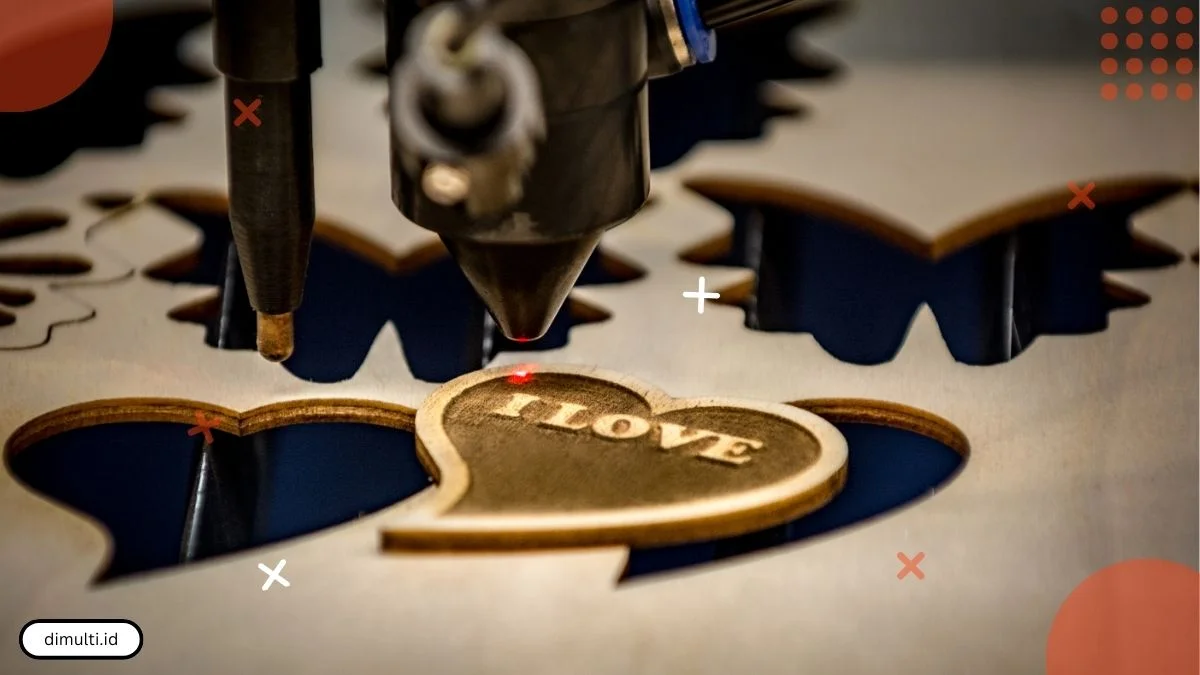
Laser cutting is a method of cutting materials that uses a high-powered laser beam to create high-precision cuts.
The process involves directing a laser beam at a specific area of the material, which then causes heating of the material to a point where it can be cut.
The laser beam is generated by a laser source that converts electrical energy into a coherent beam of light.
There are several key components in a laser cutting system, including the laser source, focusing system, and workbench.
The laser source can be gas, optical fiber, or solid crystal, and the type of laser used can be adjusted according to the type of material to be cut.
The focusing system is responsible for directing the laser beam so that it focuses on a specific point on the material, while the worktable is responsible for supporting and positioning the material to be cut.
Also Read: “5 Functions of Laser Cutting“
Types of Laser Cutting
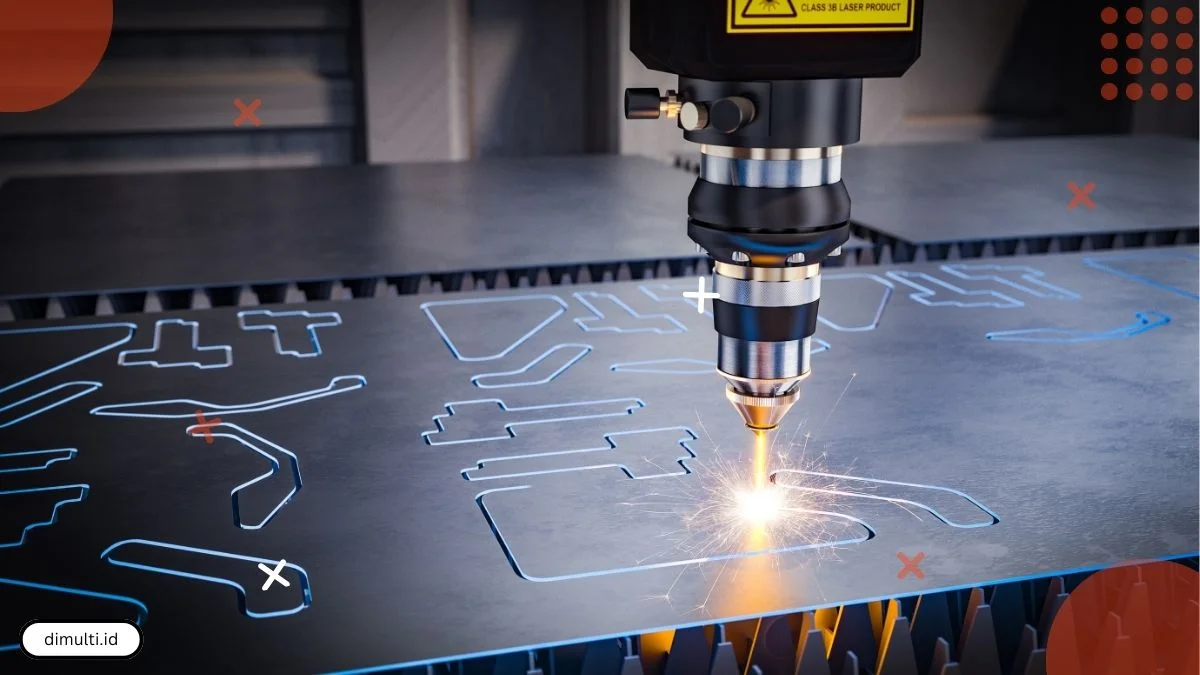
1. CO2 Laser Cutting
Laser cutting with CO2 gas uses a laser beam at a wavelength of approximately 10.6 micrometers.
This technology is perfect for cutting non-metallic materials such as paper, wood, plastic and fabric with very precise and clean results.
So, if you need to cut these materials, a CO2 laser can produce neat cuts without much additional finishing.
In addition, with the addition of certain gasses, CO2 lasers can also cut some types of metal.
But, for thicker or more complex metals, other types of lasers such as fiber lasers may be more effective.
Even so, CO2 lasers remain flexible and are widely used in various fields, both for mass production and creative projects.
CO2 lasers can also be used to engrave or mark materials, such as adding details or labels.
This makes it very useful for a wide range of applications, from manufacturing goods to custom design. So, laser cutting with CO2 is a very useful and versatile tool in many industries.
2. Nd:YAG Laser Cutting
Laser cutting using Nd: YAG crystal utilizes a laser beam at a wavelength of about 1.06 micrometers, which is shorter than that of a CO2 laser.
This technology is highly effective for cutting metals, including materials such as stainless steel and aluminum.
Because of its shorter wavelength, the Nd laser can penetrate metals with very high precision, making them ideal for applications that require precise detail and accuracy.
Nd lasers are well suited for a wide range of industrial applications that require clean and precise metal cutting, so they are often used in engineering and manufacturing fields that require precise and consistent finishes.
3. Fiber Laser Cutting
Fiber laser cutting uses reinforced optical fibers to produce a laser beam with a wavelength of about 1.06 micrometers.
This technology is very efficient in cutting metals, especially for thin metals.
Fiber lasers offer high cutting speeds and excellent cut quality, making them very popular in the automotive and manufacturing industries.
Due to its ability to cut with precision and high speed, fiber laser cutting is widely used to produce metal parts with complex details and clean finishes.
In addition, this technology is also known for its high efficiency and relatively low running costs, making it a favorite choice for various industrial applications.
4. Disk Laser Cutting
Laser cutting that uses a rotating disk makes use of laser light generated from a disk made of solid crystal or optical fiber.
This technology is highly effective for cutting metals and offers high cutting speeds.
Laser disks function by focusing a laser beam through a rotating disk, resulting in precise and efficient cuts.
This capability makes it an excellent choice for applications that require metal cutting with large volumes and intricate details.
This technology is often used in industries that require speed and accuracy in producing metal parts, such as in the automotive sector and industrial tool manufacturing.
5. Pulsed Laser Cutting
This laser cutting technology uses laser beam pulses of very short duration to prevent heat buildup around the cut area.
In this way, the cutting process is particularly effective for thin materials and situations where strict heat control is essential.
This pulse approach helps to reduce the risk of damage or distortion to the material from overheating, enabling more precise and clean cuts.
This is particularly useful for applications that require accurate control of temperature, such as in sensitive materials or in the production of components with tight tolerances.
There you have it! The 5 types of laser cutting!
It is also worth noting that the use of laser equipment is strictly regulated, and the safety standard of the laser equipment is also strictly regulated in Indonesia.
There are several standards that cover the safety procedure, up to the safety user’s guide to ensure that every product used in manufacture is a top safety priority.
The standard itself clearly stated in SNI IEC 60825-1:2011 about the safety of laser equipment classification and requirements.
And also in SNI 04-6294.1-2000 about safety at laser products that covers equipment classification, requirements and user’s guide.