
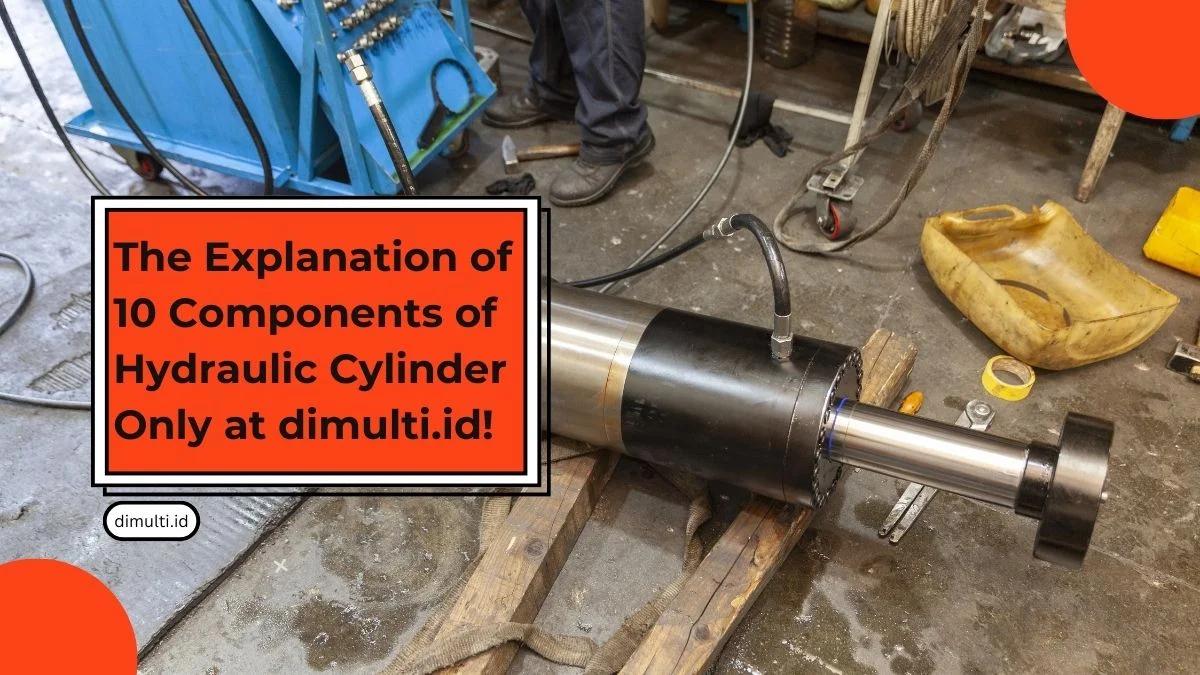
10 Components of Hydraulic Cylinder – The hydraulic cylinder is one of the most fascinating machinery that is used in various industries.
Its application in industries such as construction, manufacture makes many tasks easier to execute.
But, do you know what are the components of a hydraulic cylinder that makes the hydraulic cylinder so reliable?
Also Read

Well, without any chit-chat, let’s get the information below, only at dimulti.id!
Components of Hydraulic Cylinder

The main principle of a hydraulic cylinder is to turn a hydraulic energy into mechanical energy using a piston that can be moved by a hydraulic fluid.
It might be simple, but there are many components involved in such a simple process, and knowing and understanding every part of a hydraulic cylinder can help you to maintain and spot if there is any malfunction or damage.
1. Cylinder
As its name implies, the hydraulic cylinder consists of a cylinder that also serves as its main component.
The cylinder on the hydraulic cylinder serves as a housing where every other component, and also as every process takes place.
Other than that, it is also a place where the piston is placed and moves back and forth. The cylinder usually has a hose where the fluid can get in and out.
2. Piston
The other main part of a hydraulic cylinder is the piston that lies inside the cylinder/
When the hydraulic pressure is applied in one part of the cylinder, the piston then moves into a desired designation that causes a linear movement inside the cylinder.
3. Stod
Stod is the part that is attached to the piston and connects it to the part of the machine or equipment to be operated.
4. Seal
Hydraulic seals are used to prevent any leakage of hydraulic fluid from inside the cylinder.
There are various types of seals, such as piston seals and stod seals that are important to ensure that the system operates without leaks.
5. Valve
Hydraulic valves regulate the flow of the fluid into and out of cylinders, controlling the pressure and direction of the piston movement.
These valves help regulate the speed of movement, prevent leakage, and give precise control over the system.
Also Read: “What Are the Types of Hydraulic Cylinders?“
6. Hydraulic Reservoir
The hydraulic reservoir is used to store the hydraulic fluid (which is usually a hydraulic oil) that is used in the hydraulic system.
Well, other than just storing the hydraulic oil, these tanks also help maintaining a stable level of fluid and to provide cooling to the hydraulic fluid.
7. Hydraulic Pump
The next one is the hydraulic pump. Hydraulic pump function is to pump the hydraulic fluid into the cylinder.
This part is responsible for creating a pressure that is needed to push the piston thus creating the mechanical energy needed to move the device.
8. Hydraulic Motor
Hydraulic motors convert the hydraulic energy into mechanical energy. It’s usually used in applications where rotation movements are required, such as in hydraulic systems on vehicles.
9. Hydraulic Filter
Filters are used to clean hydraulic fluids of small particles that can damage system components. It is important to maintain system hygiene and performance.
10. Pressure Gauge and Pressure Regulator
The manometer is used to measure the pressure in the hydraulic system. In addition, the pressure regulator helps to control the pressure that flows into the cylinder.
The presence of hydraulic cylinder is crucial to make every task easier, and understanding the components of hydraulic cylinder is also mandatory to be able to maintain your manometer.
Also Read: “How Does the Hydraulic Pump Work?“
Take it as a friendly reminder, the hydraulic cylinder is one of the many products that needs to be certified by the SNI certification before being marketed and sold in the Indonesian market.
What is an SNI certification? Well, to put it simply the SNI certification is a type of product approval to ensure the safety and quality of any product and to determine whether the product is already within Indonesian standards.
The SNI certification covers almost every industry ranging from construction, medical, to agricultural industries.
Before the SNI certificate is given or issued to a certain product, the respective product needs to undergo a rigorous set of tests to ensure any aspect according to the regulation.