
What? There are types of plasma cutters that are all different and have different uses and advantages?
Yup, it is! The plasma cutter has different types, each with different uses and advantages.
But, before that, for those of you who don’t know what plasma cutting is, plasma cutting itself is a metal cutting technique that uses high-speed ionization gas to melt and remove metal material.
Also Read


The process begins by directing a stream of inert gas, such as argon or nitrogen, through a nozzle on a plasma torch until an electric arc forms to cut the material.
Plasma cutting is essential in the modern manufacturing industry as it enables mass production with a high degree of precision, as well as allowing the formation of complex shapes and designs.
Plasma cutting can also be used in a variety of other applications, ranging from construction to automotive production to provide efficient and fast solutions for cutting metals of varying thicknesses.
Check out the explanation below to get to know the types of plasma cutters and their advantages.
Types of Plasma Cutters
1. Air Plasma Cutting
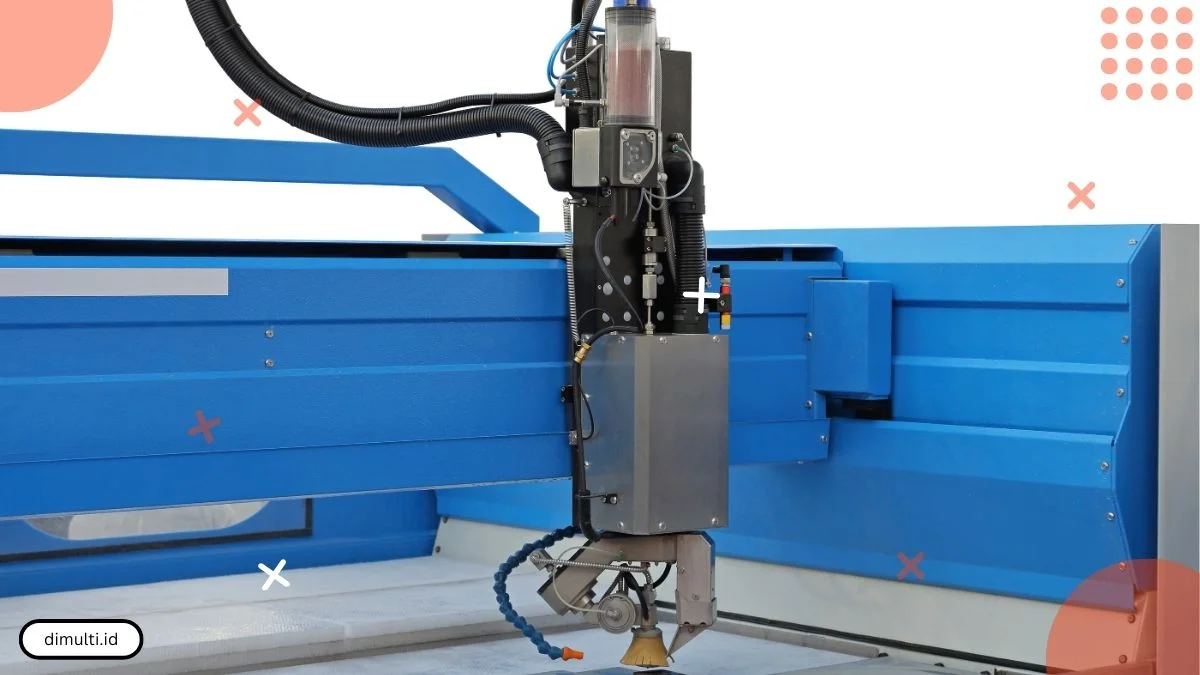
Air plasma cutting is a metal cutting method that uses air gas as a medium to form plasma.
In this process, a high-pressure air stream is used as plasma gas to generate high-pressure electricity and form an arc to cut metal.
The advantage of air plasma cutting is its lower operational cost due to the use of air as a cheaper plasma gas.
Although the accuracy is not as good as plasma cutting with inert gas, this method is still effective for metal cutting in various thicknesses.
2. Water Injection Plasma Cutting
Water injection plasma cutting is a specialized variant of the plasma cutting method that involves injecting water into the plasma stream to improve the performance and efficiency of the cutting process.
In this method, water is introduced into the plasma nozzle along with the plasma gas used, such as argon or nitrogen, reducing the risk of overheating.
The injected water forms a protective layer around the plasma arc and the material being cut, helping to cool the material and reduce the formation of smoke or dust.
3. CNC Plasma Cutting
Next is the CNC type of plasma cutting which involves the use of computer numerical control technology to automate the plasma cutting process.
The CNC system allows the movement of the cutting torch with complex and accurate shapes.
CNC plasma cutting can provide high precision and automation thus reducing the risk of human error and increasing production efficiency.
The ability to cut various shapes and patterns makes it ideal for mass production and projects with complex design needs.
Also Read: “How Plasma Cutting Works“
4. Dual-Gas Arc Plasma Cutting
Dual gas Plasma Cutting combines two gasses in the plasma stream, oxygen and nitrogen.
Generally, oxygen is used for the cutting process, while nitrogen protects the torch and workpiece from oxidation.
This method produces cuts with cleaner edges due to the use of nitrogen as a protective gas.
Other advantages of this method include the ability to cut thicker metals and a reduced risk of oxidation of the material.
5. Underwater Plasma Cutting
Next is plasma cutting which is performed below the water surface to control heat and minimize overheat.
This process is commonly used in shipyards and offshore applications that must ensure fume control for environmental protection.
The advantages of underwater plasma cutting are better fume control and reduced risk of heat exposure to the material.
The underwater plasma cutting process can also help in reducing sound and vibration during cutting.
6. Plasma Arc Cutting
Plasma Arc Cutting (PAC) is a metal cutting method that uses the high energy of a plasma arc to melt and remove metal material.
This process is similar to plasma cutting, but in plasma arc cutting, a plasma arc is formed between an adjustable electrode and the workpiece to be cut.
The main advantage of this method is its high-precision cutting results. It is also efficient in cutting thicker materials compared to other thermal cutting methods.
This method is often used in building construction and vehicle manufacturing.
So, there you have it! The types of plasma cutters!
Because it is derived from welding, plasma cutting is also one among many other things that needs to be certified by the SNI certification.
There are a lot to cover about the SNI certification of welding, such as the safety equipment that clearly stated in SNI ISO 11611:2015.