Understanding the Grinding Wheel Codes – Grinding wheels are one of the essential tools in the manufacturing industry.
They are used to sharpen, polish, or cut materials such as metal, concrete, or wood. In this industry, choosing the right grinding wheel is crucial for optimal results.
One important piece of information to understand is the grinding wheel code. Why is this important?
Also Read


Because this code provides a deeper understanding of the characteristics and specifications of the grinding wheel to be used.
So, without further ado let’s take a look at the complete information about the grinding wheel code below.
Grinding Wheel Codes
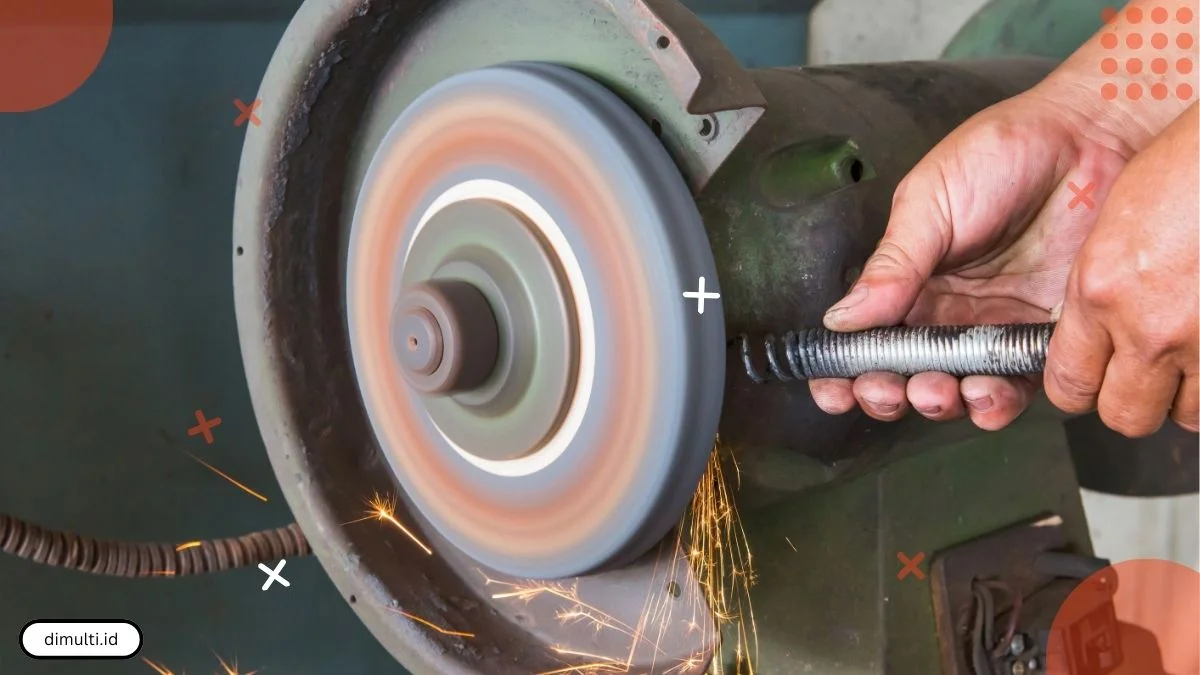
Grinding wheels are often coded as a way to identify their specifications and characteristics so that you don’t get confused when you want to use them.
There are several grinding wheel codes that are important to know. Here’s a list of some commonly used grinding wheel codes and their specifications. Check them out below.
1. Code to Determine Its Strength
The strength of a grinding wheel is determined by a code consisting of the numbers 1 to 5. A higher number indicates a harder and more durable grinding wheel.
Grinding wheels with higher strength are usually used for sharpening hard materials, while those with lower strength are suitable for softer materials.
In choosing a grinding wheel, be sure to consider the strength required.
2. Material
The next code is the code that includes information about the material and material content of the grinding wheel used in its manufacture.
Some examples of common grinding wheel material codes are as follows:
- (A) Aluminum Oxide: for cutting metal or iron.
- (C) Silicone Carbide: for cutting wheel and building materials
- (GC) Green Silicone Carbide: for cutting glass and ceramics
- (WA) White Aluminum Oxide: for cutting stainless steel
Understanding these grinding wheel material and material type letter codes can help you choose the right grinding wheel for the material you want to cut or polish.
3. Surface Roughness Level Code
Then there is also a number code that displays the surface roughness of the grinding wheel, including the following:
- 8 – 24: for rough surface
- 30 – 60: for medium surface
- 70 – 220: for smooth surface
- 221 – 800: for ultra-fine surface
- 801 – 1000: for ultra-fine surface
Also Read: “How to Choose Abrasive Wheel“
4. Codes for Hardness Level and Adhesive Strength
Codes that indicate the hardness of the grinding wheel are marked with the letters A to Z. The smaller the number associated with the letter, the harder the grinding wheel.
For example, a grinding wheel with a Z code will be harder than one with an A code.
In selecting a grinding wheel, pay attention to the material to be cut or polished as well as the desired level of smoothness.
This is important so that you can choose the appropriate grinding wheel code. Here’s a full explanation of the hardness and adhesive strength of grinding wheels:
- D, E, F, G: very soft hardness level
- H, I, J, K: moderately soft hardness level
- L, M, N, O: moderate hardness level
- P, Q, R, S: hard hardness level
- T, U V, W, X, Z: very hard hardness level
5. Code For Adhesive Types
Finally, the letter code that indicates the type of adhesion on the grinding wheel includes:
- B: for Resinoid adhesion
- BF: for Resinoid Reinforced adhesion
- V: for Vitrified adhesion
- S: for Silicate adhesion
The codes will be listed sequentially, such as A24SBF or A30RBF, on the surface of the grinding wheel.
It is important for those who wish to use grinding wheels to understand the codes described above. Ensure that the grinding wheel used is suitable for the material to be cut.