Types of Motorcycle Helmets – Helmets can protect your head from the risk of accidents. On the other hand, helmets are also useful for covering the head from hot or rainy weather.
Therefore, helmets are important complementary accessories for motorcycle riding, but do you know that in the market, there are various types of helmets with their respective features and uses?
So, if you’re confused and want to know the different types of motorcycle helmets, let’s get deeper into today’s article only at dimulti.id!


Table of Contents
Types of Motorcycle Helmets
1. Full-Face
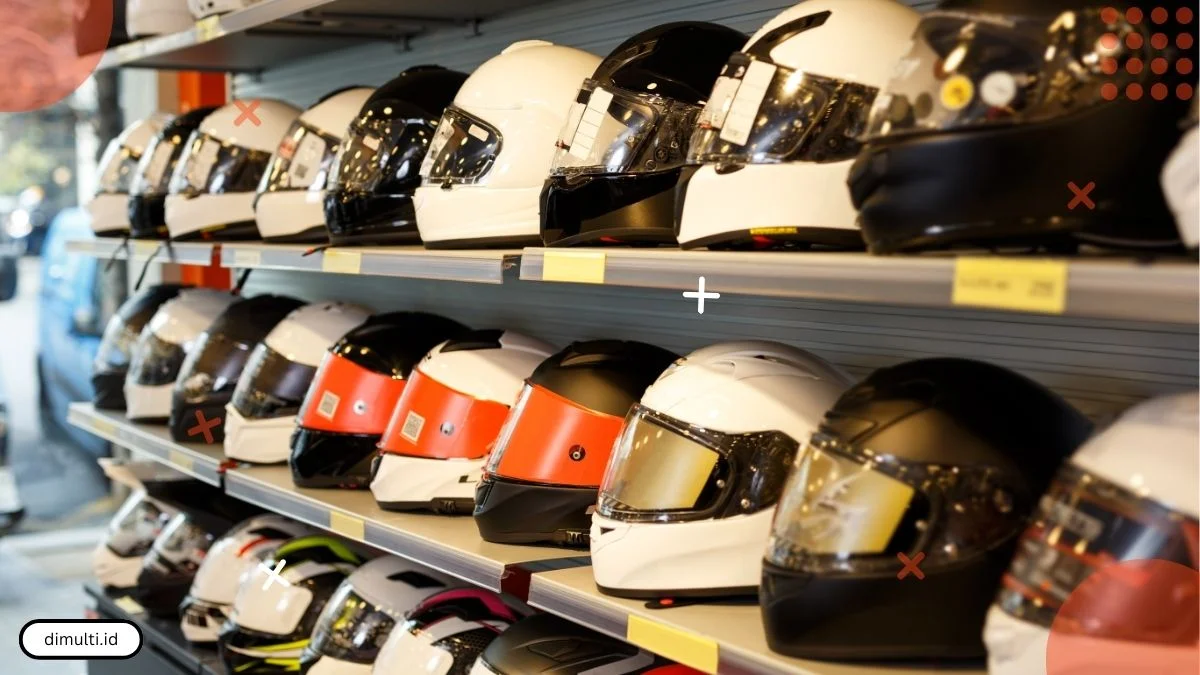
Full-face helmets are considered the safest and sturdiest helmets. And, as its name implies, these helmets protect the user’s entire face and head, and even up to the chin and neck.
They are usually equipped with a ventilation system to reduce dew on your glasses, keep your head cool, and to evaporate odors and sweat.
Full-face helmets are suitable for all-terrain and high-speed riding. However, some people might feel claustrophobic when wearing this type of helmet.
2. Modular (Flip-Up) Helmet
A flip-up or modular helmet is a combination of a full-face helmet and an open-face helmet.
It allows the visor and chin section of the helmet to be lifted with the addition of hinge-like feature, so a flip-up helmet can be used in two modes: full-face and open-face.
However, this hinge structure makes the safety of the helmet slightly lower when in open face mode, and the flip up feature also tends to make the helmet heavier than a full-face helmet.
3. Open-Face (¾) Helmet
Open-face helmets only cover the sides, top, and back of the head. The face section of these helmets is left open, but many helmet manufacturers also provide a visor to cover the face.
This type of helmet allows the wearer to breathe and feel the air well. Vision range for these helmets can also be better.
On the other hand, open-face helmets are lighter than the previous two types of helmets.
However, the safety level of open-face helmets is quite lacking as there is no sturdy chin and face cover. It is also not suitable for use at high riding speeds as it will feel unstable.
4. Half Helmet
Half helmets only protect a small part of the head, namely the upper area and around the forehead to the eyebrows, leaving most of the face and back of the head exposed.
Therefore, half helmets are considered to be not very safe for riding, especially for long distances or high speeds.
However, on the other hand, it can be worn for a relaxed riding experience due to its comfort when used.
In addition, eye protection such as riding goggles needs to be purchased separately so that dust on the road does not interfere with your visibility.
Also Read: “Top 3 Safest Motorcycle Helmet!“
5. Off-Road Helmet
As the name implies, the off-road helmet is designed for users who actively ride off-road on steep and challenging terrain.
Off-road helmets are designed differently than the full and ¾ helmets, equipped with a larger visor and a more accentuated chin bar for better airflow.
Usually, this type of helmet is designed for maximum protection with minimum weight and also prioritizes airflow for user comfort.
However, there is no eye protection feature so helmet goggles need to be worn especially if you’re going off-road. The goggles are a great choice to prevent debris or droplets from entering when you hit the dirt and mud terrains.
6. Dual-Sport Helmet
The last one is the dual-sport helmet that uses a combination of an off-road helmet and a full-face helmet, thus offering versatility in use.
This type of helmet offers a larger visor than a full-face, so it can be removed and replaced with goggles.
On the other hand, the aerodynamic visor design keeps the helmet sturdy even in the wind. The padding inside the helmet is also comfortable.
Therefore, the dual sport helmet is suitable for both off-road and on-road use.
There you have it! The 6 Types of Helmets that you need to know to ensure safe riding!