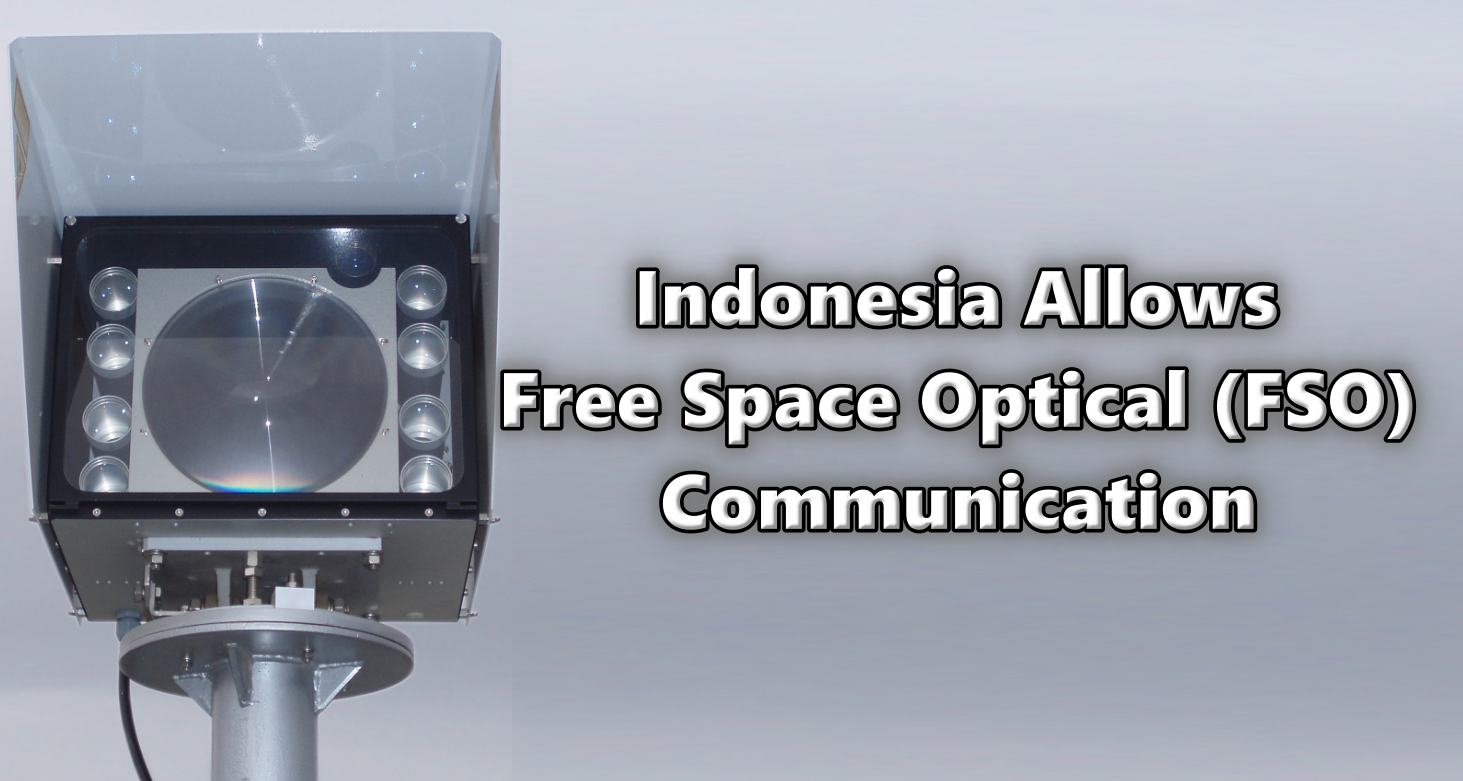
Finally, Indonesian SDPPI Allows Free Space Optical Communication for use in Indonesia. Earlier this year, SDPPI Indonesia has signed another new regulation concerning about Free Space Optics (FSO) technology. This regulation was signed on January 31st 2022 and started to be valid by the time of it’s being signed. The regulation itself is called “KEPUTUSAN MENTERI KOMUNIKASI DAN INFORMASI REPUBLIK INDONESIA NOMOR 59 TAHUN 2022”, and this particularly talks about Technical Standards of Free Space Optics (FSO). Before talking further about the regulation, let’s talk about what free Space Optical Communication is.
History of FSO Communication
The journey of free space optical communication was started a long time ago when the Greeks, initiated by Cleoxenus, Democleitus and Polybius, sent signals in the form of coded alphabetic to their troops in the battle by utilizing polished shield to reflect sun or torches light. This method then developed further in heliograph, morse, and semaphore that are used a lot during world war I.
More complex use of lights as a medium to transmit data was started by Alexander Graham Bell in 1880 by inventing Photophone in his Washington’s Volta Laboratory. Photopone is a device to transmit sound through light beam, which later on making him able to do first wireless call between two buildings in around 213 meters of distance.
Also Read
Another big step in light-utilization technology is optical speaking device, which was invented by Carl Zeiss. This device replaces traditional morse code transmission by modulating optical waves into sound or speech transmission. Therefore, people can transmit not only code, but also speech. Again, the use of this technology was in the battlefield, which is World War II.
What is Meant by Free Space Optical Communication?
The modern use of free space optical communication got a huge leap when laser was invented in 1960. From this point, we can see the advance development of free space optic communications. This is a communication technology that utilizes light propagating principle in space. By using “space” as the medium, this means that the data will be transmitted using light from one point to another through the air, vacuum, atmosphere, or even outer space. The main benefit of free space technology is the practicability and low-cost application because this doesn’t need any physical cable or wire.
Although there are many other options besides laser such as IR-emitting diodes (IREDs) or light-emitting diodes (LED s), but free space optical communication is mainly laser-driven. Laser allows data transmission in air by modulating the wavelength of the light to achieve broadband communication. And although current operation is limited to 100 Mbps or 1 Gbps, there’s rumor that 10 Gbps bandwidth of Free Space device is under development.
By using free space optical communication technology, the transmission can reach up to 5000 m or several kilos away when it is used in the suitable environment. This means between sender and receiver’s end, there should be a line-of-sight availability. With a clear line of sight, high bandwidth can be achieved. However, the light can also penetrate through the glass and other transparent surface with no attenuation, as long as the surface is clean.
What are the Advantages of FSO Communication?

As explained earlier, the main advantage of free space communication is its practicability and cost efficiency. Besides, the transmission also offers high bit rate with lower error rate. Unlike radio frequency transmission which is usually not free, free space communication is license free. And it is also more resistance to electromagnetic disturbance.
Free space optical communication is used mainly to connect between two buildings. Its wireless connection makes it possible to create a communication bridge between these two buildings without establishing any physical connection. This means that the transmission can cross any road, fields, park, or other public spaces which are not owned by both receiver and sender’s end. Besides being a bridge of two LAN segments between buildings, free space optics can also be used as back up for the existing fiber optic connection.
Disadvantages of Using FSO Technology

Free Space Optical communication is not all good things. However, there are several disadvantages it brings. Firstly, it’s about the laser lifecycle. Relatively, laser can last for about 7-8 years before it is completely unfunctional. For comparison, radio links can last longer than traditional laser. Secondly, laser-based communication system requires very rigid and firm mounting to keep the link established. This mounting requirement of course is not suitable with most of the existing communication tower. So, installing FSO means that service provider needs to invest more on the mounting base.
Last disadvantage of using FSO communication is because this technology is easy to be distracted by weather condition. Something like rain, dust, fog, or smog can get in the way and interfering the connection. Although this effect can be minimized with the current technology advancement, but in some cases, it still can be a problem. Especially in the snowy area, snow can cover the whole unit and block the light.
Free Space Optical Communication Compliance in Inodonesia
In Indonesia, the use of Free Space Optical Communication is under the regulation of Directorate General of Resources and Equipment of Post and Information Technology [SDPPI]. As mentioned in the previous paragraph, the regulation is “KEPUTUSAN MENTERI KOMUNIKASI DAN INFORMASI REPUBLIK INDONESIA NOMOR 59 TAHUN 2022”. You can find the original source of this regulation from SDPPI’s official website ion https://sertifikasi.postel.go.id/uploads/file_rumusan/174/26d8659ccc006e4a7a0fd1f0c9af155c.pdf. And below is the English translation.
By the issuance of Free Space Optics regulation in Indonesia, this means that now the country is an open market for FSO devices. Therefore, for manufacturers, distributor, or importer who wants to expand their FSO business in Indonesia, now it becomes possible. But one thing to remember is; before marketing, importing, or using your FSO devices here, there is compliance process that should be passed through. This compliance process is called SDPPI certification.
See other applicable SDPPI standards for other wireless technologies in: Regulation Reference on Indonesia SDPPI Approval (dimulti.id)
By obtaining SDPPI certificate for your products, this means that the products are already complied with local FSO regulation: “KEPUTUSAN MENTERI KOMUNIKASI DAN INFORMASI REPUBLIK INDONESIA NOMOR 59 TAHUN 2022”. Therefore, if you have any inquiry regarding Free Space Optical Communication compliance in Indonesia, feel free to drop an email to: info@narmadi.com .
DIMULTI Approval and Certification Team.